
How to Increase Vape Cart Production Throughput
To increase vape cart throughput, measure finished, sellable carts per hour rather than the filler’s cycle rate, then remove the step where carts wait longest. In most operations, that is the gap between filling and capping, manual loading, or cleaning and bagging after the fill. Integrated systems such as the Xylem X4 sort, fill, and cap 510 carts at 1,500–1,800 units per hour with one operator, and the XCB line carries that flow through cleaning and bagging at about 1,600 finished packages per hour.

What does throughput mean in vape cart production?
Throughput is the number of usable, packaged carts a line produces per hour at the intended fill weight. It is not the filler’s maximum cycle rate. A filler that runs 1,800 carts an hour adds little if carts pile up before capping, need rework for uneven fills, or wait for hand cleaning and bagging.
The slowest step sets the output of the whole line. Raising throughput means finding that step and either speeding it up or connecting it directly to the steps around it.
Where does vape cart throughput usually stall?
| Constraint | What it looks like on the floor | How automation addresses it |
|---|---|---|
| Loading and sorting | Operators place carts in trays or jigs before every run | The X4 takes carts and mouthpieces loaded in bulk without trays; the AX fills hardware straight from foam blocks |
| Fill-to-cap wait | Filled carts sit open while a tray is completed, then get capped by hand | The X4 caps each cart about 3 seconds after filling |
| Fill variation and rework | Carts pulled for weight checks, refills, or leaks | The X4 fills to ±0.25%, measured by scale, and checks every center post |
| Concentrate flow | Operators adjust temperature or pause as resin thickens | Pressurized, temperature-controlled tanks and lines hold flow steady through the run |
| Cleaning | Oil and fingerprints wiped off by hand before packing | The XC cleans and disinfects carts with isopropyl alcohol at 1,650+ units per hour |
| Bagging | Hand loading and sealing of CRP bags | The XB loads, seals, and closes the child lock on CRP and standard bags at 800+ units per hour |
Why does the gap between filling and capping limit output?
Capping is often slower than filling on manual and fill-only lines, so carts accumulate in between. That wait also affects quality: a cartridge’s vacuum lock forms when it is capped, and carts left open too long are more likely to leak. The general rule is to cap within 30 seconds, and very dilute oils need capping within about 5 seconds.
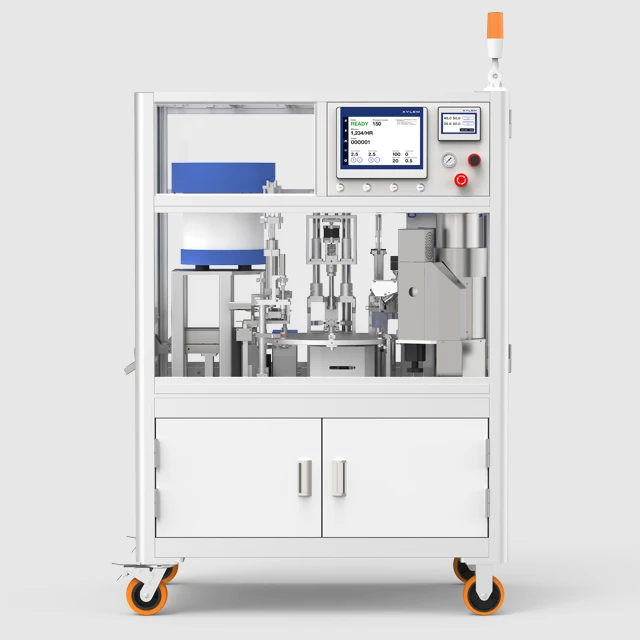
An integrated filler-capper removes the queue. The X4 Automated Cart Filler & Capper sorts, fills, and caps 510 top-fill carts one at a time, so no cart waits for a full tray to finish. It handles press, click, and screw closures. For more on how capping time affects leaks, see how to troubleshoot and prevent vape cartridge leaks.
How does fill temperature affect throughput?
Concentrate viscosity changes with temperature, and viscosity sets how fast resin can be dispensed. Warmer oil flows faster but exposes terpenes to more heat; cooler oil protects volatile compounds but moves more slowly.
Xylem publishes these operating points for the X4:
- Distillate: typically run around 60°C, for speeds closer to 1,800 units per hour
- Terpene-sensitive resins: can be filled as low as 38°C
- Range: 1,500–1,800 units per hour, up to 1,850 on select premium live resins
Speed at a given temperature depends on the formulation, so run each concentrate at its planned temperature before setting a production target. Xylem’s guide to automating live resin filling covers resin-specific handling.
How do you keep downstream steps from becoming the new bottleneck?
Once filling and capping speed up, cleaning and bagging often become the slowest steps. Compare the published rate of each station against the filler’s output before adding equipment:
| Station | Published rate |
|---|---|
| X4 fill and cap | 1,500–1,800 units per hour |
| XC cleaning | 1,650+ units per hour |
| XB bagging | 800+ units per hour |
| XCB full line | About 1,600 finished packages per hour |
A standalone XB’s published rate is below the X4’s, so confirm the bagging configuration with Xylem if bagging will run inline with an X4. The XCB Automated Vape Manufacturing Line is rated as a configured line: it sorts, fills, caps, cleans, and bags 510 carts with 1–2 people (an operator and a loader), in full- or half-line setups for pre- or post-packaging compliance testing. It uses the same pump as the X4, so it fills to ±0.25% from 38°C.
Which Xylem system fits each throughput level?
| System | Published throughput | What it automates | Staffing | Hardware |
|---|---|---|---|---|
| AX Autonomous Cart Filler | 500–700 units/hr | Filling | 1 operator | 510 carts, pods, disposables, AIOs up to 4.7 mL |
| X4 Automated Cart Filler & Capper | 1,500–1,800 units/hr (up to 1,850 on select live resins) | Sorting, filling, capping | 1 operator | 510 top-fill; press, click, screw |
| XCB Automated Vape Manufacturing Line | About 1,600 packages/hr | Sorting, filling, capping, cleaning, bagging | 1–2 people | 510 top-fill; press, click, screw |
The AX fits operations that switch hardware often. A dual RGB and LiDAR camera system maps the tray and fills without jigs, with ±0.25% fill precision, starting at $15,000, and works with all decarbed resins. It fills only, so a separate capping station has to match its output.
The X4 fits standardized 510 lines where filling and capping must stay synchronized. It is priced at $125,000. Xylem rates it at 10,000 or more finished distillate carts per 8-hour shift after warm-up, changeovers, and breaks; nonstop running would be about 13,000–14,000.
The XCB fits operations where the constraint continues after capping into cleaning and bagging.
For a full side-by-side on choosing equipment, see the vape filling machine buyer’s guide.
How much labor does automated cart production take?
Xylem publishes these labor figures for its own systems:
- X4: one operator, at about 1 cent per filled and capped unit
- XCB: 1–2 people for the full fill-to-bag line
- Headcount: Xylem says a single line replaces the workload of about 15 people, and facilities with the highest output run multiple X4s or XCB lines
Frequently Asked Questions
Remove the step where carts wait the longest. On most manual and fill-only lines, that is the gap between filling and capping. An integrated filler-capper like the Xylem X4 caps each cart about 3 seconds after filling, at 1,500–1,800 units per hour.
The Xylem X4 fills and caps 1,500–1,800 510 carts per hour with one operator, up to 1,850 on select premium live resins. The AX fills 500–700 units per hour across 510 carts, pods, disposables, and all-in-ones.
It can be used on manual lines, where speed depends on operator judgment. Xylem rates both the X4 and the AX at ±0.25% fill weight, measured by scale. Your facility still sets its own fill-weight tolerance and sampling plan.
Yes. The X4 fills as low as 38°C for terpene-sensitive resins and runs up to 1,850 units per hour on select premium live resins. Test each formulation at its planned temperature first.
The XC cleans carts at 1,650+ units per hour, and the XB bags them in standard or CRP bags at 800+ units per hour. The XCB line combines sorting, filling, capping, cleaning, and bagging at about 1,600 packages per hour.
Xylem installs the X4 on site in 1–2 days and runs a 2-day certified operator course, either at the customer’s facility or at Xylem’s location in Houston, Texas.
Xylem developed and ran its systems in its own California white-label manufacturing operation, including a licensed Type 7 facility, before selling equipment to other producers. Schedule a demo