
How to Choose a Vape Cartridge Filling Machine When Scaling Production
The best vape cartridge filling machine is the one that removes your current production constraint, not the one with the highest headline speed. Match the workflow level (manual, semi-automated, or fully automated) to sustained demand, then validate dosing accuracy, finished-unit throughput, and resin working temperature with your own oil and cartridges before you buy.
Manufacturers comparing vape filling machines for cannabis must account for volume, formulation behavior, cartridge format, quality controls, downstream steps, and available facility infrastructure. This guide walks through each of those decisions and shows where the Xylem X4 Automated Cart Filler & Capper, AX Autonomous Cart Filler, and XCB Automated Vape Manufacturing Line fit.
When Does Vape Cartridge Output Outgrow Manual Filling?
Manual filling usually stops scaling once weekly output passes about 1,000 carts, or once SKU count and resin quality requirements make hand technique too variable to standardize. At that point, filling becomes the bottleneck for every step that follows it.
Manual workflows require direct handling at filling, capping, and inspection. As production grows, those touchpoints increase labor requirements, introduce unit-to-unit variation, and create bottlenecks between process stages. Xylem’s guide on how to scale your vape cart manufacturing business breaks down the equipment, costs, and bottlenecks at each production stage.
Automation can control specific steps or connect the full workflow. The appropriate level depends on sustained demand, changeover frequency, dosing tolerance, resin working temperature, cartridge formats, and packaging requirements.
How to Match the Filling Workflow to Production Volume
Production volume determines how much automation a line can support, but volume alone does not make the decision. Product development teams often value rapid changes, while established lines prioritize repeatability and fewer manual touchpoints.
Manual Filling for Low-Volume and Development Work
Manual filling fits small runs, formulation development, cartridge trials, and workflows with frequent process changes. Operators can adjust the process quickly without configuring a larger automated system.
That flexibility requires more direct labor. Dosing, cartridge handling, capping, and inspection depend on operator technique, which creates variation across a run. Hand filling with syringes also carries high transfer loss, often around 10–20% of product. Teams need clear procedures for resin preparation, working temperature, dosing, and capping to keep results consistent.
Semi-Automated Filling for Growing Production
Semi-automated, tray-style equipment provides more repeatable dosing and faster filling while keeping operators involved. It suits growing operations that need better process control without linking every production stage.
Operators may still load cartridges, move trays, start cycles, cap units, or inspect finished carts. The equipment controls part of the process, while labor availability and operator pacing still set total output. Its practical capacity depends on the entire workflow, including the manual steps before and after filling.
Fully Automated Filling for Sustained High-Volume Output
Fully automated equipment fits sustained production where repeatable fill control, inline handling, and fewer manual touchpoints take priority. These systems can connect cartridge sorting, filling, capping, cleaning, inspection, and packaging.
Automation requires a stable operating plan. Cartridge dimensions, closure types, formulation behavior, utilities, floor space, and downstream packaging must align with the equipment configuration. Assess sustained demand rather than peak forecasts alone.
| Workflow level | Efficient output | Turnaround for a 5,000-cart order (1 worker) | Operator involvement | Primary advantages | Primary trade-offs |
|---|---|---|---|---|---|
| Manual (hand) filling | Up to about 1,000 units/week | About 2 weeks | Direct handling throughout filling, capping, and inspection | High flexibility, simple changeovers, minimal startup cost | Labor-intensive; high transfer loss; inconsistent fill lines and weights |
| Semi-automated (tray-style) filling | Up to about 5,000 units/week | About 1 week | Operators load trays, transfer, cap, or inspect, depending on configuration | More repeatable dosing and faster filling with retained flexibility | Capping and packaging can still constrain total output |
| Fully automated filling and capping | Up to about 100,000 units/week | About 1 day | Operators oversee setup, supply, quality checks, and changeovers | Repeatable control, inline handling, fewer manual touchpoints | Requires stronger format, facility, and workflow alignment |
Output ranges and turnaround times come from Xylem’s production scaling guide and vary with team size, resin, and hardware. After selecting a workflow level, validate the actual hourly requirement, dosing tolerance, resin temperature, cartridge formats, and packaging scope to find whether the filler or another stage limits output.
What Should You Evaluate in a Vape Filling Machine?
Evaluate every vape filling machine on three criteria that must work together: dosing accuracy, finished-unit throughput, and temperature control. A high hourly rate has limited value when dosing drifts or the resin needs an unsuitable process temperature.
Dosing Accuracy and Fill Consistency
Review the machine’s stated dosing tolerance or weight-deviation specification, and confirm it applies across an entire run under the formulation conditions you plan to use.
Compare like-for-like measurements. Weight deviation, volumetric tolerance, and controlled fill precision describe different performance measures and should not be treated as interchangeable.
Define how the line will catch underfilled units, overfilled units, contamination, closure problems, and visible cartridge defects. Design the process with regulatory compliance in mind while following your facility’s approved quality procedures.
Run representative material through the proposed equipment. Distillate, live resin, and live rosin place different demands on pumps, resin paths, and temperature controls. Xylem’s overview of the differences between distillate, live resin, and rosin covers how each behaves in production.
Hourly Fill Rate and Line Bottlenecks
Determine whether a stated rate measures cartridge filling or finished, packaged output. A filler may hit its target while capping, cleaning, inspection, bagging, or changeovers limit the completed-unit rate.
Map each production stage and its practical capacity:
- Unpackaging and cartridge loading
- Resin warming and preparation
- Filling
- Capping
- Cleaning and quality control
- Packaging and labeling
- Material replenishment and reclamation
Assess the slowest stage under planned operating conditions. A machine’s maximum rate does not describe production during SKU changes, cleaning, setup, or material transitions unless the specification explicitly includes those events. Your final requirement should separate filled carts from capped carts and packaged units so teams never compare different output measures as if they were the same.
Temperature Control for Thick Oils
Thick oils need a controlled working temperature that supports stable pumping and dosing. More heat lowers viscosity, but the highest available temperature is not the target.
High temperatures let resin flow more easily through a cartridge’s internal structure, so the visible fill line can drop even when the cartridge holds the same volume, as explained in Vape Filling 101. Excess heat also drives off volatile terpenes; see how temperature impacts terpenes and volatile compounds.
Xylem publishes numeric low-temperature floors for both of its fillers. The X4 operates from 38°C to 95°C, and the AX operates from 40°C to 95°C. Filling as low as 38°C on the X4 helps protect terpene profiles while giving operators process control for thick oils.
Validate temperature against the formulation, cartridge, and production time. The working range must support steady resin movement, repeatable dosing, and the intended finished-cart appearance.
Which Xylem Vape Filling System Fits Your Production?
Xylem Robotics builds automation equipment for cannabis manufacturing. Its vape systems address different constraints, from flexible multi-format filling to integrated filling, cleaning, and packaging.
AX Autonomous Cart Filler: Flexible Filling Across Formats

The AI-enabled AX Autonomous Cart Filler fits small and medium operations that run multiple cartridge formats. Dual RGB and LiDAR cameras map hardware on the platform, so operators place supplier foam blocks of unfilled carts and the AX locates and fills each injection point without jigs or specialized trays.
- Throughput: 500–700 units per hour
- Fill precision: 1%
- Transfer loss: 2% or less when processing the same batch at 2 kg or more
- Operating temperature: 40°C to 95°C
- Formats: 510 carts, pods, disposables, and all-in-ones from any manufacturer, up to 4.7 mL
- Resin contact materials: 316 stainless steel and glass, with a pressurized 2-liter stainless steel tank
- Footprint: about 5 × 5 ft working space, 120V/10A power
- Price: $15,000
The AX is a filler; capping happens at a separate step. It suits facilities where format flexibility and fast changeovers matter more than inline capping.
X4 Automated Cart Filler & Capper: High-Throughput 510 Cart Production
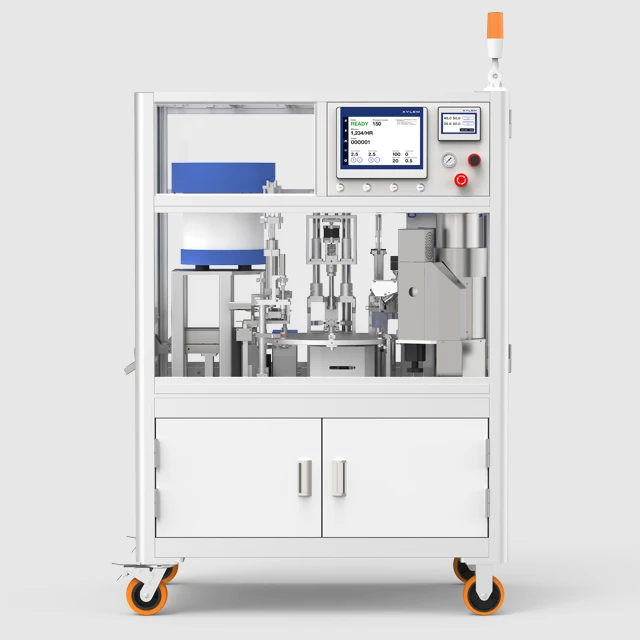
The X4 Automated Cart Filler & Capper sorts, fills, and caps 510-thread top-filled carts in one inline flow, with press, click, or screw closures. Because capping happens about 3 seconds after filling, the X4 removes the transfer between filling and capping stations and locks in the fill line with a vacuum seal.
- Throughput: 1,500–1,800 units per hour; most runs average about 1,650
- Shift output: 10,000 or more distillate carts in an 8-hour shift
- Pump accuracy: 0.25% weight deviation or less
- Operating temperature: 38°C to 95°C
- Operators: 1
- Leak control: near-instant capping plus a check of every cartridge center post
- Resin path: 316 stainless steel and ceramic, hermetically sealed and sterilizable
- Oxidation control: optional nitrogen or argon overlay in the pressurized resin tank
- Utilities: 10 × 10 ft working space, 120V/11A power, 70–90 psi compressed air at 4.6 CFM
The X4 fills all liquid decarbed concentrates, including distillate, live resin, rosin, and sauce. It runs standalone or flow-connected to cleaning and packaging equipment.
See the X4 run your own carts and oil. Xylem offers live in-person and video demos where you can test your cartridges and formulations under real production conditions. Schedule an X4 demo.
XCB Automated Vape Manufacturing Line: Integrated Packaged Output

The XCB Automated Vape Manufacturing Line connects sorting, filling, capping, cleaning, quality control, and bagging in one line. It lets manufacturers plan around packaged output rather than filler capacity alone.
- Throughput: up to 1,600 packages per hour
- Personnel: 1–2 (a primary operator plus a loader for carts, caps, and bags)
- Labor cost: about 1.2 cents per packaged unit
- Packaging: standard bags and pouches or child-resistant packaging (CRP) bags
- Compliance testing: full-line or half-line configurations for pre- or post-packaging testing
The 1.2-cent figure is Xylem’s published labor cost per packaged unit, not a payback or margin estimate. The XCB fits facilities where downstream handling limits production after carts leave the filler.
| Xylem system | Best workflow fit | Hourly capacity | Accuracy or process-control proof point | Format and downstream scope |
|---|---|---|---|---|
| AX Autonomous Cart Filler | Small to medium operations running multiple formats | 500–700 units | 1% fill precision; transfer loss 2% or less on same-batch runs of 2 kg+; fills from 40°C | 510 carts, pods, disposables, and all-in-ones up to 4.7 mL; no trays or jigs; filling only |
| X4 Automated Cart Filler & Capper | High-throughput inline 510 cart production | 1,500–1,800 units; about 1,650 average | 0.25% weight deviation or less; capping in about 3 seconds; fills from 38°C | Sorts, fills, and caps 510 carts with press, click, or screw closures |
| XCB Automated Vape Manufacturing Line | Integrated production through packaged output | Up to 1,600 packages | Configurable pre- or post-packaging compliance testing; GMP-ready automated cleaning | Filling, capping, cleaning, quality control, and bagging |
For published specs from other manufacturers side by side, see the vape filling machine comparison.
How to Plan the Facility and Implementation Before Scaling
Equipment selection must account for the material, cartridge, room, utilities, and packaging process. A strong specification on one machine cannot correct a mismatch elsewhere in the line.
Validate the Formulation and Cartridge Combination
Test the intended formulation and cartridge together. Document viscosity behavior, working-temperature range, dose target, dosing tolerance, closure type, and required quality checks.
Use production material where possible, because a substitute may behave differently through the resin path. Include each planned cart format and closure, especially when one line will handle multiple SKUs. Xylem’s list of compatible vape carts and its guide to selecting vape cart hardware help narrow the options.
Before deployment, confirm these inputs for your facility:
- Required sustained production volume
- Cartridge formats and closure types
- Resin type and working temperature
- Available footprint and utilities (power and compressed air)
- Packaging configuration, including CRP requirements
- Facility-specific regulatory and testing requirements
Record the conditions that produce stable filling and acceptable finished carts. A controlled test plan gives extraction, operations, and quality assurance teams the same basis for approval.
Map the Full Production Flow
Build a process map from resin preparation through packaged inventory. Mark where operators load components, transfer carts, inspect units, clean surfaces, and replenish packaging.
The XC Automated Cart Cleaner removes residual oil and fingerprints before packaging, and the XB Automated Vape Cart Bagger handles end-of-line packaging, including child-resistant packaging. Match both to your package format and quality-control plan. Fast capping and clean carts also reduce leak risk; Xylem’s guide on how to prevent leaks in vape cartridges covers the main causes.
For XCB planning, Xylem recommends a 10 × 40 ft working space, 120V/30A total power, and 90 psi compressed air at 12 CFM total, in an indoor lab or GMP ISO 9 or better environment. These inputs are specific to the XCB, not general requirements for every filler.
The XCB supports pre- or post-packaging testing for different regulatory environments and GMP-ready cleaning. This configuration supports a process designed with regulatory compliance in mind; it does not represent certification or guaranteed legal compliance.
Confirm Commissioning, Training, and Service
Assign responsibility for setup, operation, cleaning, quality checks, maintenance coordination, and changeovers before installation. Training should cover normal production and the response to dosing, temperature, feeding, and closure issues.
Xylem provides on-site commissioning, installation, and hands-on operator training, plus on-site and video support. Advanced operator training is available at your facility or at Xylem’s location in Houston, Texas.
Xylem spent about five years developing its systems in-house at its licensed California Type 7 facility, where it ran the company’s own white-label vape manufacturing before Xylem sold them to other operators. That production background shapes equipment setup and operator training.
Implementation planning should also define spare-material storage, cleaning access, operator movement, and escalation procedures. These details affect uptime once the machine reaches the floor.
Choose Automation Based on the Production Constraint
Match the workflow level to sustained production demand. Then validate dosing accuracy, hourly output, temperature control, cartridge formats, facility readiness, and downstream requirements against representative production conditions.
For manufacturers scaling standardized 510 cart production, the X4 combines 0.25% or less weight deviation, filling from 38°C, and inline capping in about 3 seconds, so one operator can produce 10,000 or more carts per shift.
Ready to test your production? Bring your carts and formulation to a live or video demo. Schedule an X4 demo with Xylem.
Frequently Asked Questions
A vape cartridge filling machine is production equipment that dispenses a measured dose of cannabis oil into 510 cartridges, pods, or all-in-one devices. Semi-automated machines meter each dose while an operator positions the hardware; fully automated systems such as the Xylem X4 also sort and cap cartridges inline.
Yes. Xylem offers live in-person and video demos of the X4, and customers can run the system with their own carts and vape formulations to simulate real production. Confirm sample quantity, resin condition, cart format, closure type, and dose target with Xylem before the session.
Xylem provides on-site commissioning, installation, and hands-on operator training for the X4, along with on-site and video-chat service. Advanced operator training is available at the customer’s facility or at Xylem’s location in Houston, Texas.
Bring representative resin, cartridges, closures, trays or foam blocks, and packaging components. Also provide the intended dose, quality-check plan, production target, working-temperature range, and facility constraints. Include operations, extraction, quality assurance, and maintenance stakeholders so every team assesses the process under the same conditions.