
How to Choose an Automated Cart Filler for a Growing Vape Operation
Quick answer: Choose an automated cart filler by matching it to your full production path, not just its fill speed. Compare validated hourly demand, the cartridge formats and closures you run, the fill temperature your formulations need, fill-weight accuracy, capping and inspection, and whether cleaning or packaging becomes the next bottleneck.
Key takeaways
- Automation is justified when manual filling can no longer support your production plan, quality controls, or labor model. No single unit count marks that point.
- Map the whole workflow first. A fast filler adds little if capping, cleaning, or packaging can’t keep up.
- Match the machine to your hardware mix. Standardized 510 carts favor inline filling and capping; frequently changing formats favor machine vision.
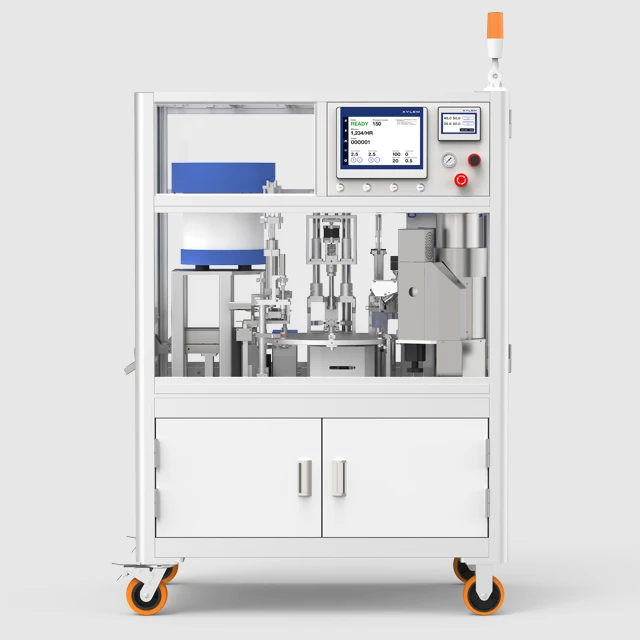
- Xylem’s X4 fills and caps 510 carts at 1,500–1,800 units per hour, the AX fills almost any format at 500–700 units per hour, and the XCB line delivers up to 1,600 finished packages per hour.
When does manual cart filling become a production constraint?
Manual filling becomes a constraint when rising output starts exposing weak spots in the process. Watch for:
- Inconsistent fills from operator to operator or shift to shift
- Handoff delays between filling, capping, and packaging
- Uneven concentrate handling as batches get larger
- Harder standardization as volume, SKU count, and staffing grow
Manual work still makes sense for limited runs, variable schedules, and early product development. For a licensed producer, co-packer, or multi-state operator (MSO), the right system fits today’s operation and planned hardware mix, with enough headroom to grow without creating a new bottleneck.
What should you define before comparing machines?
Map your actual workflow first: hardware receipt, resin prep, filling, capping, inspection, cleaning, and packaging. A fast filler adds little if operators wait for carts, pull defects by hand, or feed packaging that can’t keep up.
1. Throughput and operator model
- Measure real demand. Track sustained hourly output and peak windows, not just monthly totals.
- Find the true bottleneck. Loading, capping, QC, or packaging may set your final rate, not filling.
- Plan for growth. Size for future demand so the system doesn’t hit its limit too soon.
- Count every task. Resin prep, replenishment, checks, and changeovers all need people beyond the machine’s stated operator count.
2. Cartridge formats and closures
- Inventory your hardware. List every 510 cart, pod, disposable, and all-in-one you run or plan to run, with closure types and dimensions.
- Match the machine to your mix. Stable, high-volume 510 runs suit a dedicated inline system. Frequently changing formats get more value from machine vision.
- Test with real carts. Small differences in cart geometry and closure design can affect loading, filling, and capping.
Xylem publishes a list of compatible vape carts as a starting point.
3. Resin handling and fill temperature
Distillate, live resin, and live rosin behave differently. Classify each formulation by viscosity, temperature sensitivity, and the conditions it needs to flow consistently.
Lower fill temperatures help protect terpenes and other volatile compounds:
- X4: fills as low as 38°C
- AX: operates from 40°C
- Distillate: often run warmer, around 60°C on the X4, for speeds closer to 1,800 units per hour
During evaluation, confirm how the full resin path manages temperature from tank to tip, and check contact materials. The X4 resin path uses 316 stainless steel and ceramic.
4. Fill accuracy, capping, and quality control
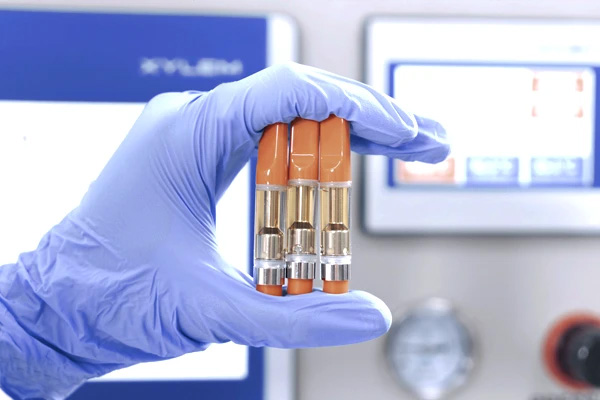
Set your fill-weight tolerance and decide who samples, what measures it, and what each run records. Then compare how each machine supports that plan. On the X4:
- Accuracy: pump weight deviation of 0.25% or less
- Capping: about 3 seconds, immediately after filling, for a strong vacuum seal
- Inspection: checks every cartridge center post
- Oxidation control: optional nitrogen or argon overlay in the resin tank
Your facility still owns verification. Confirm how the system handles defective hardware, interrupted runs, rejected units, and closure changes.
5. Cleaning, packaging, and downstream handoffs
Note every point after filling where an operator moves, stages, inspects, or reorients units. A standalone filler can fix the immediate constraint while leaving downstream work unchanged.
If several handoffs limit finished-package output, an integrated line such as the XCB Automated Vape Manufacturing Line combines sorting, filling, capping, cleaning, and packaging.
Plan cleaning, QC, and child-resistant packaging (CRP) with regulatory compliance in mind. Equipment doesn’t replace your own procedures, documentation, or jurisdiction-specific review.
How do the main cart filling approaches compare?
The main options are manual filling, a flexible autonomous filler, a high-throughput inline filler and capper, and an integrated filling-to-packaging line. Compare each against the same demand profile, hardware list, staffing plan, and downstream process. For a deeper side-by-side, see our vape filling machine comparison.
| Approach | Best fit | Throughput and staffing | Hardware and process fit | Key trade-off |
|---|---|---|---|---|
| Manual filling | Limited or variable runs where hands-on control fits the plan | Depends on labor available | Format changes handled by hand | Labor coverage, unit-to-unit consistency, and number of handoffs |
| AX Autonomous Cart Filler | Flexible filling across changing formats | 500–700 units per hour | Fills 510 carts, pods, disposables, and all-in-ones up to 4.7 mL without trays or jigs | Fill only; capping and packaging capacity must match separately |
| X4 Automated Cart Filler & Capper | High-throughput inline filling and capping of 510 carts | 1,500–1,800 units per hour (about 1,650 typical) with one operator | Sorts, fills, and caps 510 top-fill carts with press, screw, or click closures | Less suited to production plans built on non-510 formats |
| XCB Automated Vape Manufacturing Line | Operations where cleaning, QC, and bagging are part of the bottleneck | Up to 1,600 finished packages per hour with 1–2 people | Sorts, fills, caps, cleans, and packages 510 top-fill carts; standard or CRP bags | Requires planning for the full line, floor space, and material flow |
Purchase price, operating cost, facility changes, and payback depend on the final configuration. Compare total cost only after you’ve confirmed configuration and operating assumptions with the equipment supplier.
Which Xylem system fits your operation?
Choose by product mix and production path, not by a label like small, mid-sized, or large.
AX: best for format flexibility

The AX suits operations that switch hardware often. Operators place foam blocks of unfilled hardware on the platform, and dual RGB and LiDAR cameras find each injection point automatically.
- Throughput: 500–700 units per hour
- Formats: 510 carts, pods, disposables, and all-in-ones up to 4.7 mL
- Setup: no trays, jigs, or alignment
- Resin path: pressurized 2-liter stainless steel tank and stainless lines
- New formats: send Xylem two blocks of hardware; training takes about two weeks
- Published price: $15,000
The AX fills only, so make sure your capping and packaging can keep pace.
X4: best for high-throughput 510 filling and capping
The X4 suits a standardized 510-cart line that needs sorting, filling, and capping in one inline system.
- Throughput: 1,500–1,800 units per hour, about 1,650 typical
- Shift output: 10,000 or more distillate carts per 8-hour shift
- Staffing: one operator
- Closures: press, click, and screw
- Setup: no trays or jigs
Treat shift output as a capacity reference, not a guarantee. Formulation, hardware, staffing, and changeovers all affect real results.
XCB: best when downstream work is the bottleneck

The XCB suits facilities where the constraint continues after filling. It links filling and capping to cleaning and packaging, removing separate handoffs.
- Throughput: up to 1,600 finished packages per hour
- Staffing: 1–2 people (operator plus loader)
- Carts: 510 top-fill with press, screw, or click closures
- Packaging: standard or CRP bags
- Compliance testing: full- or half-line configurations for pre- or post-packaging testing
Not ready for a full line? The XB Automated Vape Cart Bagger and XC Automated Vape Cart Cleaner can be added separately.
Why Xylem’s operating background matters
Xylem Robotics is based in Houston, Texas, with California operations that include a licensed Type 7 facility. Its systems ran Xylem’s own California white-label manufacturing before the company sold equipment to other operators. That experience shapes equipment design and support, but it doesn’t replace your own site testing and quality review.
What site requirements should you plan for?
Each system has different space and utility needs. All three are rated for indoor lab or GMP ISO 9 (or cleaner) environments.
| System | Recommended working space | Power | Compressed air |
|---|---|---|---|
| AX | 5 ft × 5 ft | 120V, 10A | Optional, 70 psi @ 1.6 CFM |
| X4 | 10 ft × 10 ft | 120V, 11A | 70–90 psi @ 4.6 CFM |
| XCB | 10 ft × 40 ft | 120V, 30A total | 90 psi, 12 CFM total |
Choose automation that removes your next bottleneck
Select a cart filler by tracing your full production path. Compare hardware mix, resin handling, fill consistency, capping, labor, quality controls, and downstream handoffs against validated demand. The AX supports format flexibility, the X4 delivers high-throughput inline 510 filling and capping, and the XCB covers the full path from filling to packaging.
Frequently Asked Questions
Look at throughput against your validated hourly demand, compatibility with your cart formats and closures, the lowest fill temperature it supports, fill-weight accuracy, how it caps and inspects carts, and whether downstream cleaning and packaging can keep up. The right machine removes your actual bottleneck instead of moving it.
It depends on the system. The Xylem AX fills 500–700 units per hour, the X4 fills and caps 1,500–1,800 units per hour with one operator, and the XCB line produces up to 1,600 finished packages per hour with one or two people.
Fill at the lowest temperature that keeps your formulation flowing consistently, since lower heat helps preserve terpenes. The Xylem X4 can fill as low as 38°C and the AX operates from 40°C. Thinner formulations such as distillate are often run warmer, around 60°C, for higher throughput.
Yes, with a vision-based filler. The Xylem AX fills 510 carts, pods, disposables, and all-in-ones up to 4.7 mL without dedicated trays or jigs. The X4 and XCB are built specifically for 510 top-fill carts.
Bring representative carts, closures, formulations, fill volumes, and final packaging, including your hardest or highest-priority SKUs. Share your expected production schedule and quality checks. Xylem offers both in-person and video demos where you can run your own carts and formulations.
Xylem provides on-site commissioning, installation, and hands-on operator training, with advanced training available at your facility or at Xylem’s Houston location. Ongoing support includes on-site service and video chat. Decide before purchase which employees and shifts need training.
No. No machine guarantees regulatory compliance. Xylem systems are designed with compliance in mind, but the licensed operator remains responsible for its procedures, documentation, and approvals. Get qualified guidance for legal or regulatory questions.